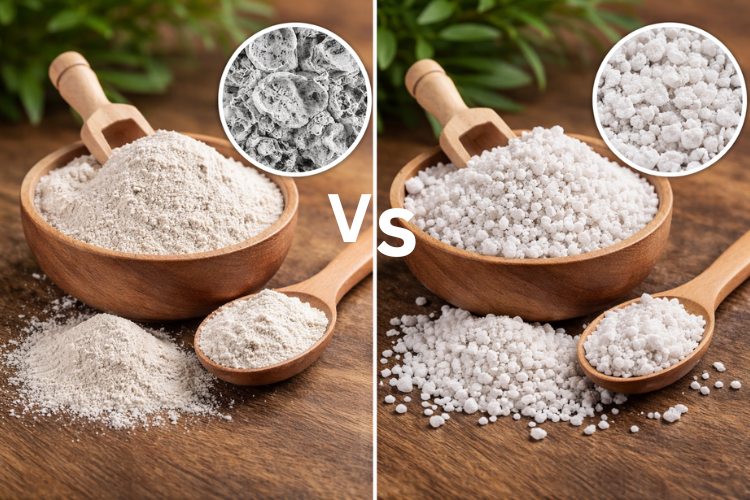
When people hear terms like diatomaceous earth and Perlite, they often assume they’re basically the same thing. Both are lightweight. Both show up in gardening, filtration, and industrial applications. Both even look somewhat similar at first glance.
But once you actually start working with them, the differences become pretty obvious.
Choosing the wrong material for a project can lead to poor results, wasted money, and unnecessary frustration. So it helps to understand where each one works best and why.
What Is Diatomaceous Earth?
Diatomaceous earth, often called DE, is a naturally occurring soft sedimentary material formed from fossilized remains of microscopic aquatic organisms called diatoms.
That sounds scientific, but the material itself feels like a very fine powder.
Because of its porous structure, diatomaceous earth is commonly used for filtration, pest control, absorbents, and even some industrial processes. It can absorb moisture well and has a high surface area, which makes it useful in several applications.
One thing people notice quickly is how dusty it can get. Handling it carelessly often creates a fine cloud that spreads everywhere.
What Is Perlite?
Perlite is a volcanic glass material that expands when heated at high temperatures. Once expanded, it becomes extremely lightweight and porous.
The texture looks more like tiny white granules or lightweight particles rather than powder.
Perlite is widely used in construction materials, insulation, filtration systems, horticulture, and lightweight concrete products. In gardening, people use it to improve soil aeration and drainage. In construction, it helps reduce overall structural weight while improving thermal performance.
And unlike diatomaceous earth, perlite feels much cleaner and easier to handle during application.
The Biggest Difference: Structure and Texture
This is where the two materials really separate.
Diatomaceous earth has a powdery texture. It’s finer, softer, and much more absorbent.
Perlite, on the other hand, has an expanded granular structure. It traps air inside tiny cells, making it lightweight while still maintaining strength and stability.
That difference affects how each material performs.
If someone needs moisture absorption or ultra-fine filtration, diatomaceous earth usually works well. But when lightweight strength, insulation, aeration, or reduced density matter more, perlite becomes the better choice.
Which One Works Better in Construction?
For construction applications, Perlite often has the advantage.
Why? Because it offers a combination of low weight, thermal insulation, fire resistance, and durability. Builders use it in lightweight plasters, insulation boards, ceiling tiles, and construction aggregates.
Diatomaceous earth has more limited structural applications because of its powdery nature.
Filtration Performance Matters Too
Interestingly, both materials are heavily used in filtration.
Diatomaceous earth performs extremely well in fine filtration because of its microscopic porous structure. It’s commonly used in swimming pool filters and industrial liquid filtration.
Perlite also works as a filter aid, but it’s often preferred when lighter density and easier handling are important.
The choice usually depends on the exact filtration requirement.
Final Thoughts
Both materials have genuine strengths, but they are built for different purposes.
Diatomaceous earth works well for absorption and fine filtration. Perlite covers more ground across construction, insulation, horticulture, and industrial filtration. Amol Minechem Limited has been producing and supplying perlite products in India since 1982, making them one of the most experienced names in the field. From filter aids to cryogenic insulation to horticultural grades, their range is built to meet the needs of industries that depend on consistent quality and reliable supply.