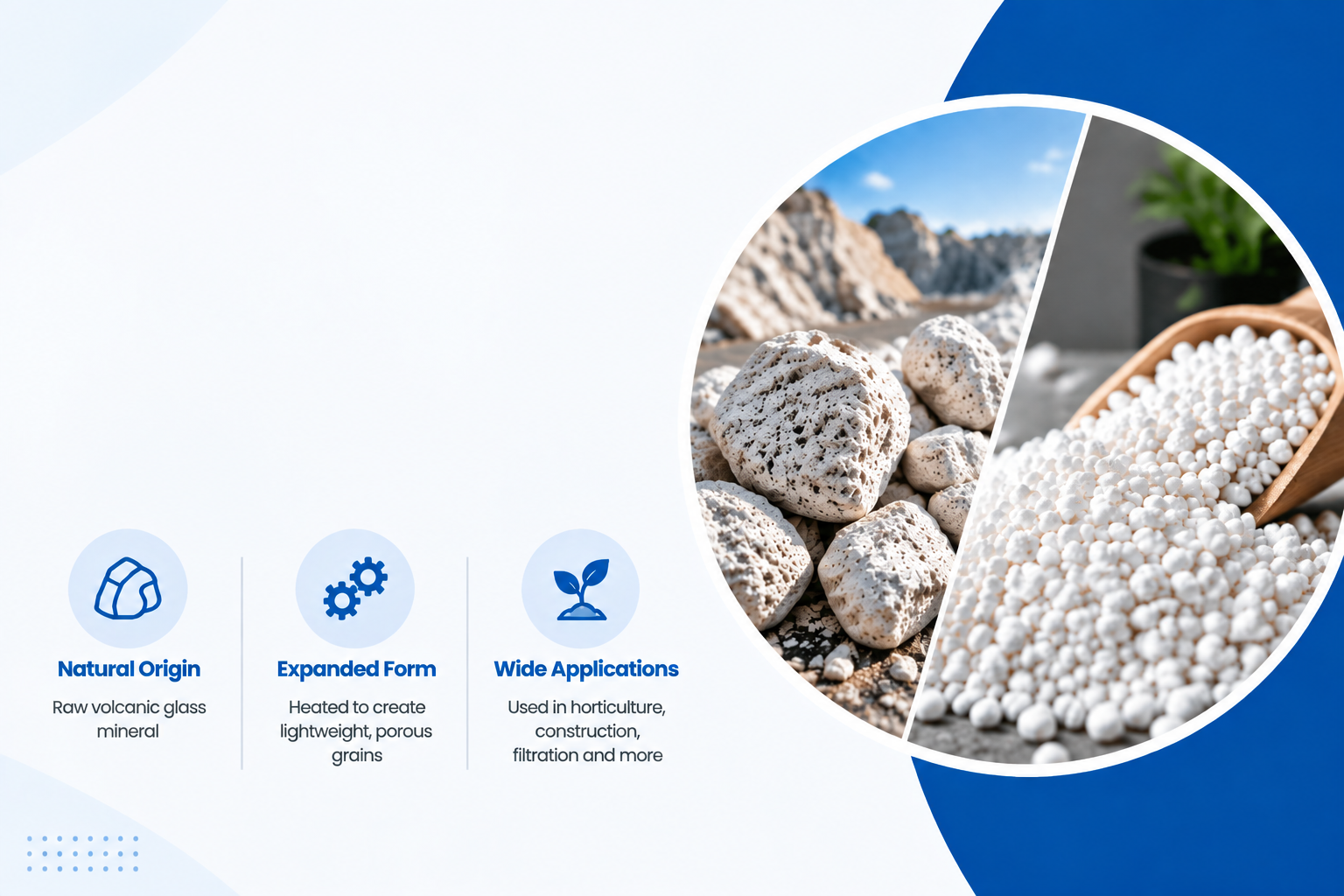
Perlite may look like an ordinary mineral, but its form can change significantly depending on how it is processed. Natural perlite is a volcanic glass formed when lava cools, while expanded perlite is produced by heating natural perlite to high temperatures. The two materials, therefore, share the same origin but differ in structure, weight, and applications. Knowing the differences can help you choose the right type, especially when selecting expanded perlite for horticulture, construction, or industrial applications.
1) How Are They Made?
Natural perlite is a naturally occurring volcanic material formed when silica-rich volcanic rock cools. It contains trapped water within its structure, which is important because this moisture allows the material to expand when heated.
Expanded perlite begins as natural perlite but undergoes controlled heating at high temperatures. The water inside the particles turns into vapour, causing the material to expand dramatically and form a lightweight, porous structure.
2) Appearance And Texture
Natural perlite is generally denser and has a solid, glassy appearance. Depending on its source and processing, it can range from grey or brown to lighter shades. Its structure is considerably less porous than expanded perlite.
Expanded perlite is typically white or light grey and has a distinctive, lightweight, granular appearance. Heating creates numerous tiny air spaces within each particle, giving it a porous texture that makes it useful for aeration and insulation.
3) Weight And Structure
Natural perlite is relatively dense because its original volcanic structure remains largely intact. It does not have the highly expanded cellular structure associated with processed perlite, so it is less suitable when extremely low weight is an important requirement.
Expanded perlite is much lighter because the heating process creates internal pores. This low density makes it useful in applications where reducing weight matters, including lightweight growing mixes, insulation materials, and certain construction products.
4) Common Applications
Natural perlite is mainly used as a raw material that can be processed further. Its composition and properties make it valuable for producing expanded perlite and for selected industrial applications where its original mineral characteristics are suitable.
Expanded perlite has a wider range of practical uses because its porous structure provides useful properties. It is commonly found in horticultural growing media, lightweight construction materials, insulation, filtration, and other applications requiring a lightweight and absorbent material.
5) Water And Air Management
Natural perlite has a much more compact structure, so it does not provide the same level of air-filled pore space associated with expanded material. Its usefulness for improving drainage or aeration in growing media is therefore more limited in its natural form.
Expanded perlite can hold some moisture while also creating spaces that allow air to move around plant roots. This combination makes it popular in horticulture, where good drainage and root aeration are important for healthy plant growth.
You can also read: Amol Minechem Limited’s Unlocking the Potential of Expanded Perlite Powder
In Conclusion
Natural and expanded perlite come from the same volcanic source, but processing gives them very different physical properties. The right choice ultimately depends on what the material needs to do! Understanding how heating changes perlite makes it easier to select the appropriate form for horticultural, construction, insulation, or industrial needs.
Explore Amol Minechem’s product range and discover the right mineral solution for your needs!